

Work Package WP3 Leader / Project Director
Prof. Michał Boćkowski, PhD
Institute of High Pressure Physics of the Polish Academy of Sciences (IHPP PAS)
Main Objectives
The objective of research package WP3 is to develop and investigate gallium nitride doped with selected rare-earth ions (RE) for applications in single-photon sources (Single-Photon Sources – SPS) and integrated quantum sensors.
Scientific and technological tasks include:
- Precision control over rare-earth ion incorporation (erbium – Er, terbium – Tb) into the GaN crystalline matrix via ion implantation.
- Optical activation of luminescent centers using Ultra-High Pressure Annealing under nitrogen atmosphere (UHPA), preventing GaN decomposition at elevated temperatures.
- Characterization and annealing of radiation-induced lattice damage in GaN.
- High-resolution spectroscopy of individual emission centers and assessment of room-temperature quantum coherence.
Research Strategy and Innovation
Native, dislocation-free GaN bulk crystals and epitaxial layers developed at IHPP PAS offer a globally unique platform for engineering quantum emitters. Unlike heteroepitaxial structures grown on foreign substrates (e.g., sapphire, silicon), the near-complete absence of extended dislocations ensures an exceptionally low non-radiative noise background and enhanced optical stability.
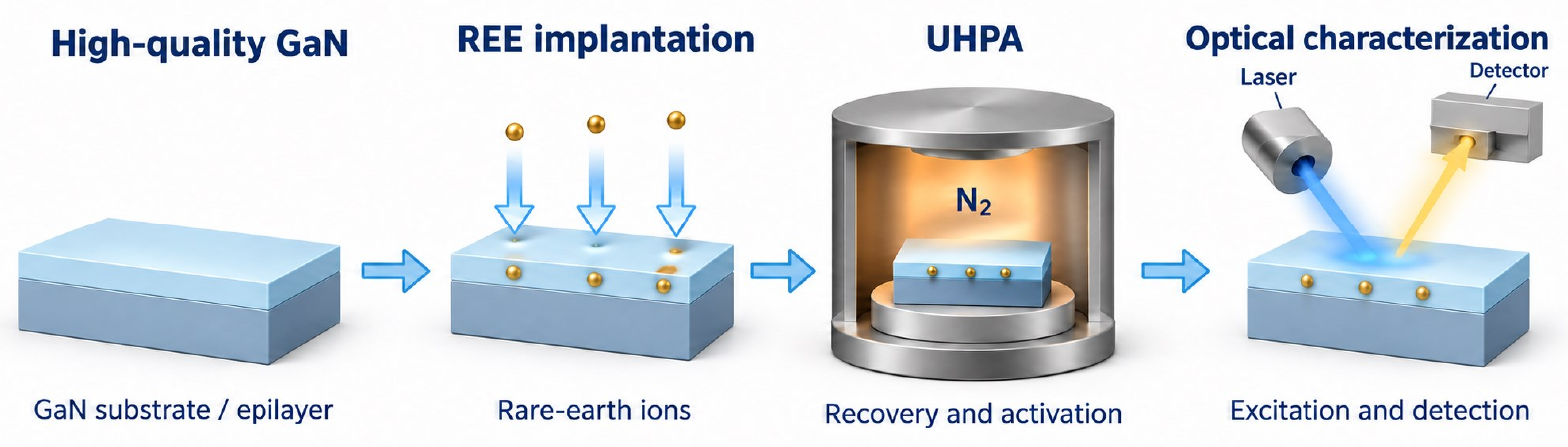
Fig. 1. Technological and characterization route for rare-earth doped GaN: ion implantation, UHPA annealing, and advanced luminescence spectroscopy.
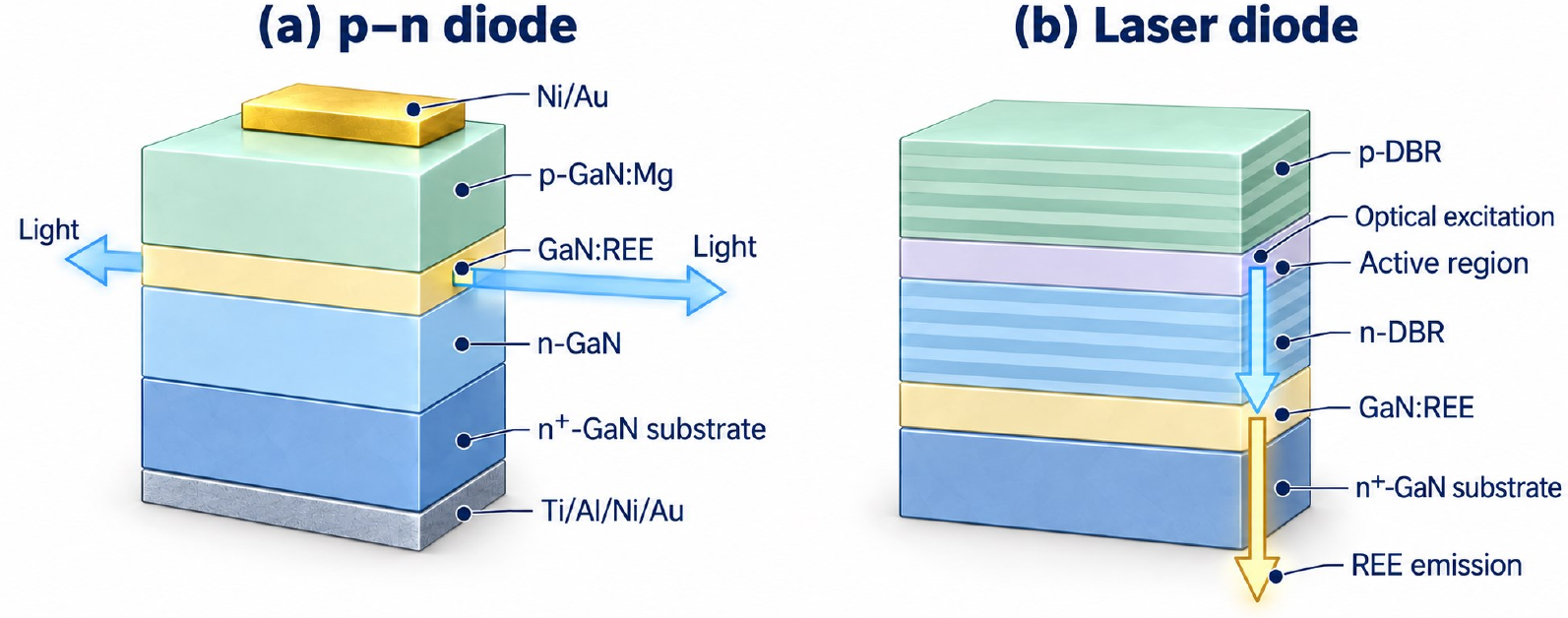
Fig. 2. Proposed device concepts for electrical excitation of rare-earth luminescent centers in gallium nitride.
Current Status and International Collaboration
- Implantation Parameter Tuning: Initial doping profiles and fluences for Er and Tb ions across various beam energies were determined through stopping-and-range simulations.
- UHPA High-Pressure Processing: High-pressure autoclaves were prepared for annealing runs at pressures of 10–20 kbar and temperatures exceeding 1200°C.
- Defect Characterization: To evaluate vacancy creation and annihilation kinetics following implantation, collaboration was established with Prof. Filip Tuomisto’s group at the University of Helsinki using Positron Annihilation Spectroscopy (PAS).
Next Steps
- Executing planned ion implantation series with Er and Tb on selected high-perfection GaN substrates.
- Performing high-pressure UHPA annealing and optimizing activation temperatures and residence times.
- Temperature-dependent photoluminescence (PL) spectroscopy to identify and isolate targeted dopant transitions.