

Work Package WP4 Leader
Paweł Kempisty, PhD, Eng.
Institute of High Pressure Physics of the Polish Academy of Sciences (IHPP PAS)
Role in the Project and Objectives (Materials Informatics)
Work package WP4 serves as the analytical and computational hub of the “GaN-Unipress” project. Its overarching mission is to transform heterogeneous technological and laboratory knowledge into standardized, machine learning-ready datasets (AI-ready data), while building predictive modeling tools that support packages WP1–WP3.
Activities within WP4 are organized into 5 pillars:
- Data Analytics and Selection: Curating datasets (including rich historical ammonothermal growth records) that address critical process optimization questions.
- Data Standardization and Ingestion: Converting disparate run logs, measurements, and micrographs into machine-readable tabular and tensor formats.
- Data Repository: Establishing a central data management system ensuring full traceability, searchability, and genealogical tracking of specimens.
- Predictive Modeling (AI/ML): Mapping physical process parameters to crystal morphology, defect emergence, and electrical performance.
- Digital Twin: Constructing virtual multiscale simulations of autoclave growth to dramatically reduce empirical trial-and-error iterations.
The “Digital Crystal” Concept
The cornerstone of the WP4 architecture is the creation of a Digital Crystal object linked to a persistent identifier (ID), unifying:
- Computer Vision Descriptors: Contours, surface area, estimated volume, seed boundaries, lateral growth zones, and macroscopic defects.
- Structural and Physical Metrics: High-resolution XRD/XRT maps, rocking curve widths, optical transmittance, and electrical characteristics.
- Process History: Autoclave run ID, spatial basket position, pressure-temperature time-series, and genealogical ancestry (parent–child lineage between seed generations).
- CFD Simulation Features: Spatially resolved temperature profiles, buoyancy-driven flow velocity fields, mass transport rates, and supersaturation levels in the supercritical fluid.
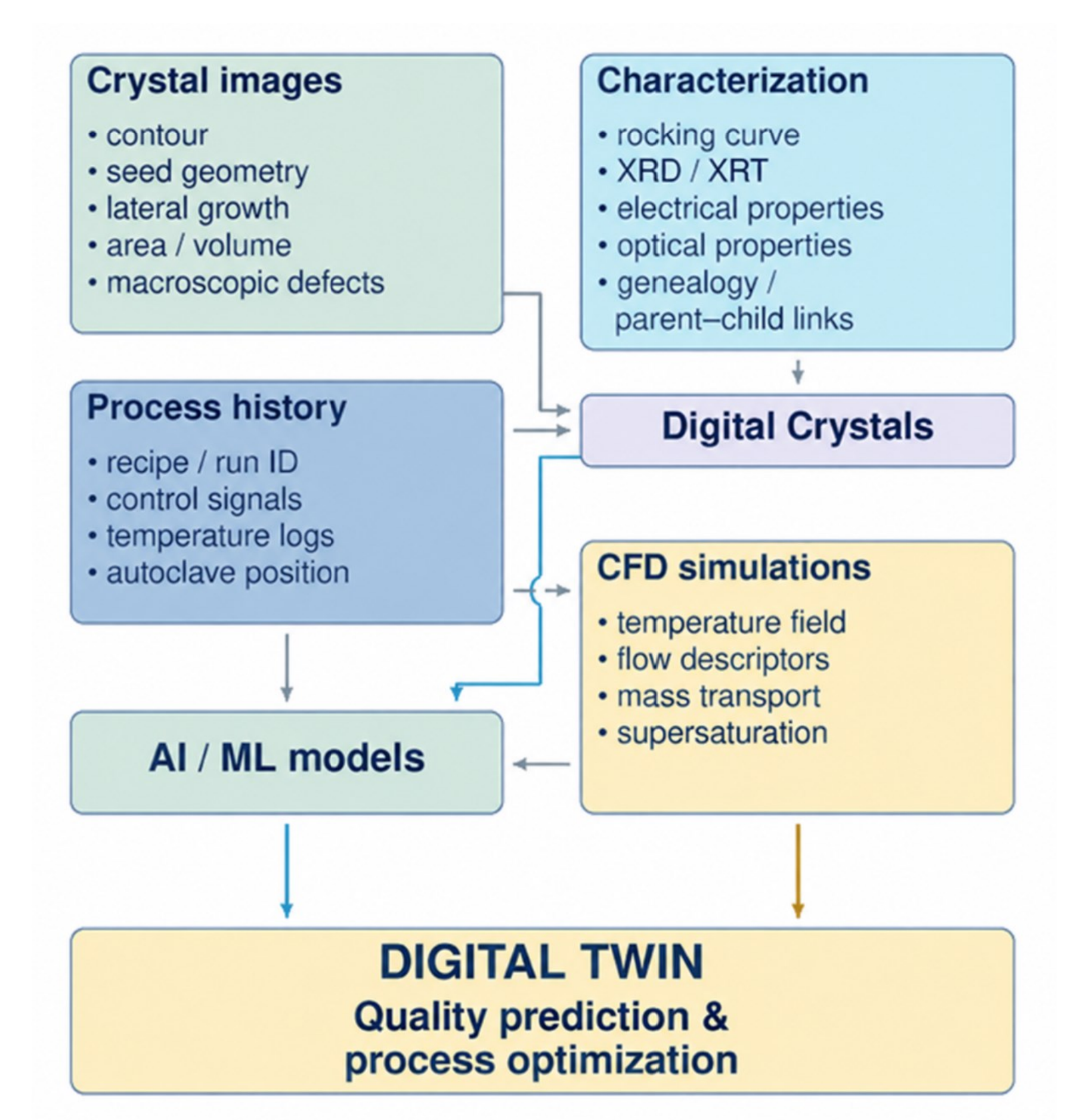
Fig. 1. Architecture of the ammonothermal digital twin: integrating experimental datasets, digital crystal objects, CFD multiscale modeling, and reduced-order AI/ML surrogates.
Computer Vision and AI Tools for the Pilot Line
To support the high-throughput requirements of the WP1 pilot crystallization line, automated inspection pipelines are being developed:
- Hybrid Vision Approach (OpenCV + ML): Fast, deterministic computer vision algorithms (Python / OpenCV) handle camera calibration, contour extraction, and area quantification ($px \to mm^2$), while deep neural networks classify subtle surface morphology variations and complex defect modes.
- Quantitative Defect Scoring: Prototype algorithms segment and quantify defect regions in cross-polarized light (cracks, misoriented crystallites, high-strain fields), providing rapid macro-screening before downstream processing.
- Autoclave Time-Series Mining: In-situ temperature logs and actuator control signals are correlated with final crystal quality to uncover micro-transients and thermal fluctuations undetectable from nominal recipes alone.
Current Progress
- Completed an in-depth audit of historical ammonothermal growth logs (Ammono database) and formulated hardware specifications for local GPU computing nodes and storage servers.
- Deployed first-generation Python/OpenCV prototypes for automated crystal boundary segmentation and defect area fraction calculation.
- Established standardized schemas for high-frequency autoclave time-series logs and structural defect taxonomy in close collaboration with WP1 process engineers.